
A História da Música Gospel
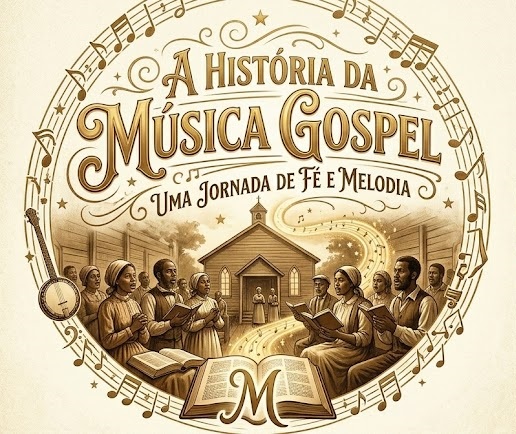
The History of Gospel Music
The genre known as "gospel music" is characterized by a style formed and produced to express Christian beliefs, whether individual or from a specific community. Just like other genres of Christian music, the creation, influence, performance, and even the characterization of gospel music change according to the social and cultural context.
The gospel style is written and performed for various reasons—ranging from aesthetic pleasure, religious or ceremonial purposes, to a product meant to entertain the commercial market. However, the core principle of the gospel genre boils down to worship, praise, or giving thanks to God, the Holy Spirit, or Christ.
History of the Gospel Musical Style
Regarding the history of gospel or evangelical music, even though the term "Gospel Music" can encompass an incredibly broad musical landscape, its various styles—under different names—share the identical root and essence: African-American Christian music.
Negro Spirituals is perhaps one of the oldest styles of Black music that directly approached what we know as Gospel. The focal point of this short history is a music that moved beyond the African-American church and served as an inspiration for a cornucopia of modern choirs, today's Contemporary Christian Music (CCM), and Rhythm & Blues artists, not to mention many other subgenres.
The "infant child" of Gospel music, fueled by a multi-billion dollar American recording industry, leaped from its simple, Christian cradle, scaled the church walls, and entered the highly diverse market we see today.
Gospel continues to grow. According to Gospel Today, an American magazine, between the years 2003 and 2008, seven major record labels created specialized divisions solely to handle Gospel artists. Statistics from the same publication indicated that independent labels experienced a 50% growth, while sales revenue for the Gospel style alone tripled over the final decades of the 20th century, surging from $180 million in 1980 to $500 million in 1990.
Origins of Gospel Music
The composer behind classics like There Will Be Peace in the Valley, Thomas A. Dorsey, is recognized by many as the "Father of Gospel Music." At the beginning of his career, Thomas was a prominent Blues pianist popularly known as "Georgia Tom."
He began writing Gospel after hearing Charles A. Tindley at a musicians' convention in Philadelphia. While he abandoned the more aggressive lyrics of his previous songs, he kept a Jazz-infused rhythm very similar to Tindley's style.
Initially, the Church did not approve of Dorsey’s style, considering it inappropriate for the sanctuary at the time. In 1994, after his passing, the American magazine Score published an article titled "The Father of Gospel Music." The piece noted that when Dorsey realized early on that many were fighting against the Gospel style, he stood "determined to carry the banner" in its favor. And that is exactly what he did.
He invested in 500 copies of his song If You See My Saviour and sent them to numerous churches across the country. It took nearly three years for him to secure more orders for the song, during which time he almost returned to the Blues.
However, Dorsey did not give up. With the help of other talented musicians, he pushed forward. He worked alongside singers Sallie Martin and Willie Mae Ford Smith. He wrote hundreds of Gospel songs and eventually watched his music rise into church pulpits. Dorsey was also responsible for founding the National Convention of Gospel Choirs and Choruses in 1932, an organization that still exists today at the bedrock of the gospel style.
Development of the Musical Style
Several other fresh names emerged—individuals who might once have been "prisoners of an old chain, but were now saved," ready to fuel this new wave of Gospel music. Examples include Clara Ward, Mahalia Jackson, and James Cleveland.
Mahalia Jackson was invited to perform on the televised Ed Sullivan Show, just minutes before Martin Luther King Jr.’s historic speech for freedom. Mahalia was later invited to sing at Rev. King's funeral, where, in a profoundly moving moment, she chose to perform Dorsey's song, "Take My Hand, Precious Lord."
Clara Ward, along with The Ward Singers, was a powerhouse of presence and content. Her song Surely God is Able was cited as the first unreleased platinum record after World War II. However, this fact remains unconfirmed, as the RIAA recognizes the Edwin Hawkins Singers as the first to win a gold record for a Gospel track in 1968 with the popular hit "Oh, Happy Day"—dating from when the RIAA began tracking record sales statistics. Nevertheless, Ward was a massive influence on many artists, including Aretha Franklin and Little Richard.
As for James Cleveland, if Dorsey was hailed by the industry and followers as the father of gospel, singer Cleveland was crowned by admirers as "The King of Gospel." He won four Grammys, including a posthumous award for the album Having Church. Much like Clara Ward, James held a powerful connection with his audience; he didn't have a reputation for having a traditionally "perfect" voice, but he knew exactly how to move those who listened to him.
His greatest achievement was founding the Gospel Music Workshop of America in 1967. Today, it is recognized as the largest Gospel convention on Earth, featuring more than 185 representative chapters spread across the United States.
Gospel in the Modern Market
In its original form, Modern Gospel was typically interpreted by a soloist, accompanied by a choir and a simple instrumental ensemble. Many major American performers started this way, singing gospel in churches. This is the case for Bessie Smith, Mahalia Jackson, Ray Charles, Aretha Franklin, and Solomon Burke.
The gospel style continued to evolve, occasionally taking on forms that surprised the religious establishment. This occurred with Gospel quartets after World War II, which introduced shouting vocals, extravagant clothing, and high-energy dances. This very style heavily influenced rock singers and groups of the 1950s, starting with Bill Haley and his Comets, moving through Jerry Lee Lewis, and extending to Elvis Presley in the 1960s. From the 80s and 90s onward, soloists and choirs gained massive importance, with figures like Fred Hammond and Kirk Franklin taking center stage.
Gospel Music and Elvis Presley
Elvis Presley was undoubtedly one of the greatest proponents of the gospel music style throughout the 20th century. Elvis deeply admired the genre alongside blues, country, rock, classical music, and R&B. From the 1950s onward, Elvis incorporated the distinct influences of this uniquely American style into his tracks and albums.
Notable examples include the vocal backing of the gospel group The Jordanaires, followed later in the late 1960s and early 1970s by The Imperials. During the same era, he worked with The Stamps (featuring J.D. Sumner), the female vocal group The Sweet Inspirations, and singer Kathy Westmoreland.
Elvis released four gospel albums: Peace In The Valley (1957), His Hand in Mine (1960), How Great Thou Art (1967)—which became a defining milestone in his career—and He Touched Me (1972).
To truly understand Elvis's impact on American gospel, the artist won his only three competitive Grammys for his gospel performances in 1967, 1972, and 1974. In 2001, he was posthumously inducted into the Gospel Music Hall of Fame, forever cementing his name within this highly influential American musical tradition. Among his gospel successes, global hits like Crying in the Chapel (1965), Peace in the Valley, and How Great Thou Art stand out. Many consider Elvis one of the greatest performers of the traditional Southern Gospel style.
The Success of Brazilian Gospel Music
Gospel music has seen explosive growth worldwide and notably within Brazil. Uniting more than one musical genre under a single concept—songs featuring evangelical or Christian themes—the gospel style has become a massive slice of the market, drawing substantial corporate attention.
In Brazil alone, this market was moving roughly R$ 1.5 billion annually as of 2014 data, directly and indirectly employing a total of 2 million individuals during that period. In 2009, total sales of gospel DVDs, CDs, and digital media yielded R$ 359 million in the country. Also in 2009, ECAD collected R$ 358 million in copyright royalties. Gospel songs are routinely among the most played on the radio, and its albums consistently rank among the top sellers. The gospel boom has additionally driven the commercialization of sound equipment, musical instruments, and accessories for enthusiasts and musicians alike.
Due to the impressive numbers of a sector growing at roughly 15% annually, Universal Music inaugurated a dedicated label for the style in the country. To put it in perspective, the gospel sector in the United States represents about 6% of all music market sales—which is more than Latin and Electronic music sales combined.
The sector in Brazil is following the exact same trajectory. The Universal Music Christian Group label arrived in Brazil prepared to invest heavily in Brazilian artists and launch international names locally. According to José Éboli, then President of Universal Music Brazil, Brazilian artists are poised to conquer international markets—pointing to cases like singer Thalles Roberto, who had a project lined up for international projection via Motown Gospel, an arm of Universal Music.
Sony also holds its own specialized label, Sony Music Gospel. Additionally, there are numerous small and medium-sized independent labels—whether associated with major record companies or not—investing heavily in the gospel style.
And the gospel market's influence extends far beyond music. Expocristã, an event entirely tailored to this consumer base, features everything from customized Bible covers to tailored tourism packages, running since 1992. In its 2010 edition, the fair attracted over 220,000 attendees.
In 2013, the fair took a temporary hiatus, and in its place came a different event called the International Christian Fair (Feira Internacional Cristã - FIC). Later, the company Um Entretenimento, led by Léo Ganem, acquired the Expocristã brand.
Major media networks like Rede Globo also invested heavily in the market, eyeing the purchasing power of the evangelical consumer base by generating targeted event programming. While some of these initiatives faced setbacks—such as the 2013 FIC fair not yielding the expected success and the cancellation of the Troféu Promessas music awards due to corporate restructuring and label imbalances—the overall demand remains strong.
Many secular record labels continue to seek out gospel talent, though not all maintain an independent, dedicated branch for it. Entities directly managed by evangelical organizations often see higher trust and a greater rate of long-term success. Furthermore, evangelical-managed educational institutions in Brazil gathered an impressive 740,000 students by 2014 metrics, representing a highly concentrated potential consumer base. The evangelical purchasing demographic remains a driving force, bolstering statistics and proving the massive, ongoing success of this musical genre in Brazil.
Deja tu comentario
Nota: ¡El código HTML no será interpretado!